After so many costumes sewn for nobility and so many high-class characters played, one of my latest characters is a victorian housemaid on her way to becoming a lady's maid. That means plain costumes - and frilly aprons. The important thing with this kind of aprons is that they usually come with a bib, not just the skirt-part, and that they usually aren't pinafores anymore but are tied.
The first apron I made is a very plain one, for cooking or gardening or other dirty work, made from unbleached cotton . The skirt part is plain with two pockets to be tied at the back and has three buttonholes at the front for the bib which can be buttoned on. The straps cross at the back and are buttoned to the apron strings. And as I saw this in many pictures and documentaries I made a pair of protective sleeves from the same fabric, they seem to have been very popular in those days to save your clothes from stains.
The second apron is decorative, made entirely from light, machine-embroidered cotton fabric. The bib is attached to the apron, again the straps cross at the back and are buttoned to the strings. For decoration the straps are completely lined with ruffles.
Sunday, 3 May 2015

Thursday, 9 April 2015
Period films for inspirational purposes ;)
If you simply can't watch TV without stitching, knitting, doing something you will appreciate a collection of films fitting the era of your recent costume-in-progress. There's a few hidden gems especially for the baroque era, as I recently discovered. I'll just list them here without much further ado, maybe a word or two on their quality of dress and plot, or a warning if they're too gruesome to watch :D Some of them are truly inspiring in their quality of costumes, others are just nice fillers for a sewing evening. The whole list to be completed, as all of my projects...
Antique
Medieval
Renaissance
La Reine Margot (1994)
Dangerous Beauty (1998)
The Merchant of Venice (2004)
Elizabeth I. (2005)
Elizabeth: The Golden Age (2007)
La Princesa de Éboli (2010)
Isabel, la Reina (2011)
Baroque
By the Sword Divided (BBC-series, 1983-85)
Cyrano de Bergerac (1990)
Black Robe (1991)
The Three Musketeers (1993)
La Fille de d'Artagnan (1994)
Le Bossu (1997)
Le Roi Danse (2000)
Vatel (2000)
Saint-Cyr (2000)
Alatriste (2006)
Snapphanar (2006)
Molière (2007)
Sluga Gosudarev (The Souvereign's Servant, Слуга государев, 2007)
The Devil's Whore (2008)
The Three Musketeers (2011) - Plot is horrid, the king's outfits nice. Forget the rest...
The Three Musketeers (Tri Mushketera, miniseries, 2013)
Las aventuras del capitán Alatriste (TV-series, 2013)
Definitely NOT recommending the 2014 BBC-Musketeers, as plot AND costumes are crap...
Tale of Tales (2015)
The Girl King (2015) - forget it unless you're keen on Alice's Red Queen...
Rococo
Barry Lyndon (1975) - Perfect costumes despite dating from 1975!
The Last of the Mohicans (1992)
Rob Roy (1995)
Catherine the Great (1995)
Ridicule (1996)
The Scarlet Pimpernel (BBC-series, 1999-2000)
Le Pacte des Loups (2001)
The Lady and the Duke (2001)
Fanfan la Tulipe (2003)
Jeanne Poisson Marquise de Pompadour (2006)
The Duchess (2008)
Belle (2013)
Outlander (TV-series, 2014- )
Regency
Sharpe's Regiment (TV-series, 1993-2008)
Sense and Sensibility (1995)
Persuasion (1995)
Pride and Prejudice (1995)
Emma (1996)
Emma (British version, 1996)
Hornblower (1998-2003)
Mansfield Park (1999)
Pride and Prejudice (2005)
Persuasion (2007)
Northanger Abbey (2007)
Mansfield Park (2007)
Becoming Jane (2007)
Miss Austen Regrets (2008)
Sense and Sensibility (2008)
Lost in Austen (2008)
Emma (2009)
Love and Friendship (2016)
Mary Shelley (2017)
later 1800s
The Age of Innocence (1993)
Cranford (BBC-series, 2007)
Lark Rise to Candleford (TV-series, 2008)
Return to Cranford (2009)
The Invisible Woman (2013)
Once Upon a Time in Wonderland (miniseries, 2013-2014)
Ripper Street (TV-series, 2013-2017)
In Secret (2014)
Penny Dreadful (TV-series, 2014)
early 1900s
A Promise International (2013)
Summer in February (2013)
Winter's Tale (2014)
Fantasy
The Lord of the Rings (2001-2003)
Antique
Medieval
Renaissance
La Reine Margot (1994)
Dangerous Beauty (1998)
The Merchant of Venice (2004)
Elizabeth I. (2005)
Elizabeth: The Golden Age (2007)
La Princesa de Éboli (2010)
Isabel, la Reina (2011)
Baroque
By the Sword Divided (BBC-series, 1983-85)
Cyrano de Bergerac (1990)
Black Robe (1991)
The Three Musketeers (1993)
La Fille de d'Artagnan (1994)
Le Bossu (1997)
Le Roi Danse (2000)
Vatel (2000)
Saint-Cyr (2000)
Alatriste (2006)
Snapphanar (2006)
Molière (2007)
Sluga Gosudarev (The Souvereign's Servant, Слуга государев, 2007)
The Devil's Whore (2008)
The Three Musketeers (2011) - Plot is horrid, the king's outfits nice. Forget the rest...
The Three Musketeers (Tri Mushketera, miniseries, 2013)
Las aventuras del capitán Alatriste (TV-series, 2013)
Definitely NOT recommending the 2014 BBC-Musketeers, as plot AND costumes are crap...
Tale of Tales (2015)
The Girl King (2015) - forget it unless you're keen on Alice's Red Queen...
Rococo
Barry Lyndon (1975) - Perfect costumes despite dating from 1975!
The Last of the Mohicans (1992)
Rob Roy (1995)
Catherine the Great (1995)
Ridicule (1996)
The Scarlet Pimpernel (BBC-series, 1999-2000)
Le Pacte des Loups (2001)
The Lady and the Duke (2001)
Fanfan la Tulipe (2003)
Jeanne Poisson Marquise de Pompadour (2006)
The Duchess (2008)
Belle (2013)
Outlander (TV-series, 2014- )
Regency
Sharpe's Regiment (TV-series, 1993-2008)
Sense and Sensibility (1995)
Persuasion (1995)
Pride and Prejudice (1995)
Emma (1996)
Emma (British version, 1996)
Hornblower (1998-2003)
Mansfield Park (1999)
Pride and Prejudice (2005)
Persuasion (2007)
Northanger Abbey (2007)
Mansfield Park (2007)
Becoming Jane (2007)
Miss Austen Regrets (2008)
Sense and Sensibility (2008)
Lost in Austen (2008)
Emma (2009)
Love and Friendship (2016)
Mary Shelley (2017)
later 1800s
The Age of Innocence (1993)
Cranford (BBC-series, 2007)
Lark Rise to Candleford (TV-series, 2008)
Return to Cranford (2009)
The Invisible Woman (2013)
Once Upon a Time in Wonderland (miniseries, 2013-2014)
Ripper Street (TV-series, 2013-2017)
In Secret (2014)
Penny Dreadful (TV-series, 2014)
early 1900s
A Promise International (2013)
Summer in February (2013)
Winter's Tale (2014)
Fantasy
The Lord of the Rings (2001-2003)
Thursday, 15 January 2015
Silver-green elven robe
I decided that I need a decent elvish outfit. Well, actually it was decided for me, and my "partner in crime" and I left the fabric store shouldering a huge roll of pale green, silvery velvet, 18 metres of it, to be made into two elven robes and a dress. I decided to go for a waterlily-design on my robe, as the colour reminded me of a pond and corresponds perfectly with silver and pale greens.
The pattern of the gown itself is, once again, based on my all-time-favourite princess dress pattern that I slit at the front, added about an ell of train and almost floor-lenght sleeves. All parts are lined with very light green fabric. The robe got a hood because someone was of the opinion that a decent elven robe needs a hood. I haven't needed it yet, but it does look good - and it's one piece more to put embroidery on!
Embroidery was, to be honest, the main reason for this design. I'm working with six-threaded cotton yarn and slender metallic silver trim. All the water lines and waves are done in silver, the water-lilies in white and off-white, their leaves in pale green and light green. I use two colours aside each other and entwine them a bit to get a lively, natural mixture. The silver trim is sewn on in simple running stitch, the yarn runs along only at the surface and is whip-stitched to the fabric. The ends are pulled through and secured with a knot on the left side of the fabric.
The pattern of the gown itself is, once again, based on my all-time-favourite princess dress pattern that I slit at the front, added about an ell of train and almost floor-lenght sleeves. All parts are lined with very light green fabric. The robe got a hood because someone was of the opinion that a decent elven robe needs a hood. I haven't needed it yet, but it does look good - and it's one piece more to put embroidery on!
Embroidery was, to be honest, the main reason for this design. I'm working with six-threaded cotton yarn and slender metallic silver trim. All the water lines and waves are done in silver, the water-lilies in white and off-white, their leaves in pale green and light green. I use two colours aside each other and entwine them a bit to get a lively, natural mixture. The silver trim is sewn on in simple running stitch, the yarn runs along only at the surface and is whip-stitched to the fabric. The ends are pulled through and secured with a knot on the left side of the fabric.
Light-blue 1630s gown
Inspired by the costumes from the series "By the Sword Divided" (and by the fact that actually I should finish the ballgown, but another new dress for the meeting before the ball would be just too nice...) I was highly motivated to make some more 1630s-style dresses. I ended up with six new fabrics and decided to use one that had been sitting at the back of my wardrobe for the past dunnohowmany years. The lovely light-blue jacquard (cotton-rayon-mix, for a change) told me it wanted to become my next gown. Now. Before the ballgown. I did lots of research to get an authentic pattern and to discover how on earth the skirt was attached to the high-waisted bodice without adding too much bulk, for clearly those dresses weren't two-pieced. The internet knows everything, but it doesn't know this. And the books may know it but I found none that would tell me. In the end I decided to use my fitted semi-authentic pattern and toy with the skirt until it worked. And it worked. Rather quickly. So now I hope also the six new fabrics will soon be made into more gowns for my vain countess! ;)
The chemise this time is made the original way, with separate starched collar and cuffs to pin or sew on before wearing and take off again before washing. The lace was bought approximately at the same time as the fabric and takes up the palmette-pattern. And this time the shape of the collar is not cut but made by sewing tucks into a long rectangle that give it a round shape to follow the neckline.
The bodice follows exactly the pattern I used for my dark-blue baroque dress, except I shortened the tabs. As I was planning to sew the skirt to the bodice I wouldn't need the long tabs to hide the white chemise underneath. The skirt is sewn right into the seam above the tabs, and the closure corresponds nicely with the little slit in the skirt's side seam. A satin ribbon decorates the high waist, the bowtie hides hook and eye. Great thing to have a box full of ribbons in all colours of the rainbow (and some more) to choose the matching colour from! ^^
The sleeves were the part I wanted to improve this time. The sleeves of my previous two early-baroque gowns were still not full enough, to my linking, so I added more volume and, as I have already two dresses with closed sleeves, slit these at the front. Also a very popular variation in those days. The edges are embroidered with little pearls, satin bow-ties decorate the upper end of the slit. Avoid flimsy art-silk lining. But the colour matched so nicely, and I liked the shimmer...
The skirt of this dress is not just a long rectangle sewn into a tube and then gathered, but has its seams cut a little on the bias so the waist is narrower than the seam - and hence less fabric has to be pleated into the waistline, which otherwise might make it look plump. Also there's no slit at the back, but a slit in the side-seam so skirt and bodice both close at the front.
And the very best thing: this gown can be put on in no time! Perfect for someone who wants to change three times a day at a roleplay :D
In this two pictures there's no matching chemise yet, I was in a hurry finishing the dress itself.


The chemise this time is made the original way, with separate starched collar and cuffs to pin or sew on before wearing and take off again before washing. The lace was bought approximately at the same time as the fabric and takes up the palmette-pattern. And this time the shape of the collar is not cut but made by sewing tucks into a long rectangle that give it a round shape to follow the neckline.
The bodice follows exactly the pattern I used for my dark-blue baroque dress, except I shortened the tabs. As I was planning to sew the skirt to the bodice I wouldn't need the long tabs to hide the white chemise underneath. The skirt is sewn right into the seam above the tabs, and the closure corresponds nicely with the little slit in the skirt's side seam. A satin ribbon decorates the high waist, the bowtie hides hook and eye. Great thing to have a box full of ribbons in all colours of the rainbow (and some more) to choose the matching colour from! ^^
The sleeves were the part I wanted to improve this time. The sleeves of my previous two early-baroque gowns were still not full enough, to my linking, so I added more volume and, as I have already two dresses with closed sleeves, slit these at the front. Also a very popular variation in those days. The edges are embroidered with little pearls, satin bow-ties decorate the upper end of the slit. Avoid flimsy art-silk lining. But the colour matched so nicely, and I liked the shimmer...
The skirt of this dress is not just a long rectangle sewn into a tube and then gathered, but has its seams cut a little on the bias so the waist is narrower than the seam - and hence less fabric has to be pleated into the waistline, which otherwise might make it look plump. Also there's no slit at the back, but a slit in the side-seam so skirt and bodice both close at the front.
And the very best thing: this gown can be put on in no time! Perfect for someone who wants to change three times a day at a roleplay :D
In this two pictures there's no matching chemise yet, I was in a hurry finishing the dress itself.


Silver-grey renaissance dress
The upcoming baroque ball's motto is winter, which leaves only a small range of colours to choose from. Luckily I have some metres of grey jacquard (actually enough for two dresses - and a justaucorps, as we discovered) on stock that I decided to use for this project, together with some very nice silvery fabric for the petticoat. And pearls for decoration.
The chemise or shift is an authentic pattern from around 1600, made of very light cotton batiste. The long sleeves are cut very wide to allow them to puff out between the gown's slit sleeves and decorated with white tulle lace. Not absolutely period because they would rather have used reticella, guipure or bobbin lace (at least to my knowledge), but hey, neither is the polyester jacquard ;) At least I'll be able to put everything into the washing mach... no wait, again I won't, because of the pearl embroidery I'm planning. Anyway... The neckline is very wide and can be adjusted with a drawstring. No frills or lace here because the standing collar will be put on separately.
The bodice consists, again, of two layers of sturdy fabric with sandwiched-in boning. Heavy boning at the front to achieve the typical flat renaissance chest, only a few bones at the sides and at the back to keep the shape. The tabs are half-ovals, pearl-rimmed, as is the neckline and the sleeves. The sleeves are long and narrow, showing the lace of the chemise. The slits at the shoulder are lined with pearls and let the chemise peep through. I hope the sleeves are long enough to provide enough fabric... The shoulders are additionally decorated with fake bows, just to add some more stuff.
The jacquard overskirt and the petticoat are sewn together and close at the front, hidden under the stomacher. The thus two-layered skirt is tied to the bodice with satin ribbon and shows the front of the petticoat. The petticoat is made of two different fabrics. One plain light-grey for the parts that won't be seen, and one shiny silvery fabric at the front that is embroidered with pearls. To keep the overskirt from slipping back and showing the plain fabric part, it's tied to the seam of the petticoat with two satin bows.
The standing ruff is a long, heavily starched piece of tulle lace, cut to match the shape of the neckline and supported by a wire supportasse. Both are carried by a piece of brocade filling in the back neckline. The whole construction thus is detachable and the dress can be worn with or without the ruff.
A venetian flag fan completes the whole ensemble. The handle is aluminium, the flag part is cardboard covered in the matching grey brocade, rimmed with pearls, topped with a pearl ornament and I had a single silver tassle left that also went onto it. One homeless piece less in my overflowing collection of might-need-it-for-something-one-day-stuff ;)
And to round the whole thing off I made matching jewelry: five rows of white crystal beads with a snowflake-pendant for the necklace, a matching bracelet (that will hardly be seen because of the long sleeves, hadn't thought about that!), and earrings with little crystal drops.


The tiara was the mad idea of one evening too many spent sewing. The thought was that a fluffy skirt like this and that huge ruff can do with something that would otherwise be too top-heavy: a tiara resembling icicles. So off to buy chandelier crystals and make myself the ice queen of the ball! :D

As always, good pics still to come... ;)
The chemise or shift is an authentic pattern from around 1600, made of very light cotton batiste. The long sleeves are cut very wide to allow them to puff out between the gown's slit sleeves and decorated with white tulle lace. Not absolutely period because they would rather have used reticella, guipure or bobbin lace (at least to my knowledge), but hey, neither is the polyester jacquard ;) At least I'll be able to put everything into the washing mach... no wait, again I won't, because of the pearl embroidery I'm planning. Anyway... The neckline is very wide and can be adjusted with a drawstring. No frills or lace here because the standing collar will be put on separately.
The bodice consists, again, of two layers of sturdy fabric with sandwiched-in boning. Heavy boning at the front to achieve the typical flat renaissance chest, only a few bones at the sides and at the back to keep the shape. The tabs are half-ovals, pearl-rimmed, as is the neckline and the sleeves. The sleeves are long and narrow, showing the lace of the chemise. The slits at the shoulder are lined with pearls and let the chemise peep through. I hope the sleeves are long enough to provide enough fabric... The shoulders are additionally decorated with fake bows, just to add some more stuff.
The jacquard overskirt and the petticoat are sewn together and close at the front, hidden under the stomacher. The thus two-layered skirt is tied to the bodice with satin ribbon and shows the front of the petticoat. The petticoat is made of two different fabrics. One plain light-grey for the parts that won't be seen, and one shiny silvery fabric at the front that is embroidered with pearls. To keep the overskirt from slipping back and showing the plain fabric part, it's tied to the seam of the petticoat with two satin bows.
The standing ruff is a long, heavily starched piece of tulle lace, cut to match the shape of the neckline and supported by a wire supportasse. Both are carried by a piece of brocade filling in the back neckline. The whole construction thus is detachable and the dress can be worn with or without the ruff.
A venetian flag fan completes the whole ensemble. The handle is aluminium, the flag part is cardboard covered in the matching grey brocade, rimmed with pearls, topped with a pearl ornament and I had a single silver tassle left that also went onto it. One homeless piece less in my overflowing collection of might-need-it-for-something-one-day-stuff ;)
And to round the whole thing off I made matching jewelry: five rows of white crystal beads with a snowflake-pendant for the necklace, a matching bracelet (that will hardly be seen because of the long sleeves, hadn't thought about that!), and earrings with little crystal drops.


The tiara was the mad idea of one evening too many spent sewing. The thought was that a fluffy skirt like this and that huge ruff can do with something that would otherwise be too top-heavy: a tiara resembling icicles. So off to buy chandelier crystals and make myself the ice queen of the ball! :D

As always, good pics still to come... ;)
Wednesday, 29 October 2014
Pyjama-hotpants
Perfect little thing to sew if you happen to find some adorably cute piece of fabric. They basically consist of light cotton fabric, cotton bias-tape in a matching colour, elastic band and a satin bow for decoration. And a little pocket at the back.


The latest design is white with cute little red hearts, the next one will be with "kiss me"-text design ^^

The latest design is white with cute little red hearts, the next one will be with "kiss me"-text design ^^
French Royal Banners
I admit a slight obsession with fleur-de-lys ever since... - well, let me just assure you there's a very good reason behind each and every of my whims ;) Hence I decided we need some decoration for our liveroleplays and I will stitch a banner.
The idea:

The fleur-de-lys are sized A4, so the whole thing is pretty big. And as I couldn't decide whether to make a banner with six A4-sized or with three A3-sized lilies, I went for both. Why decide if you can have it all ;)
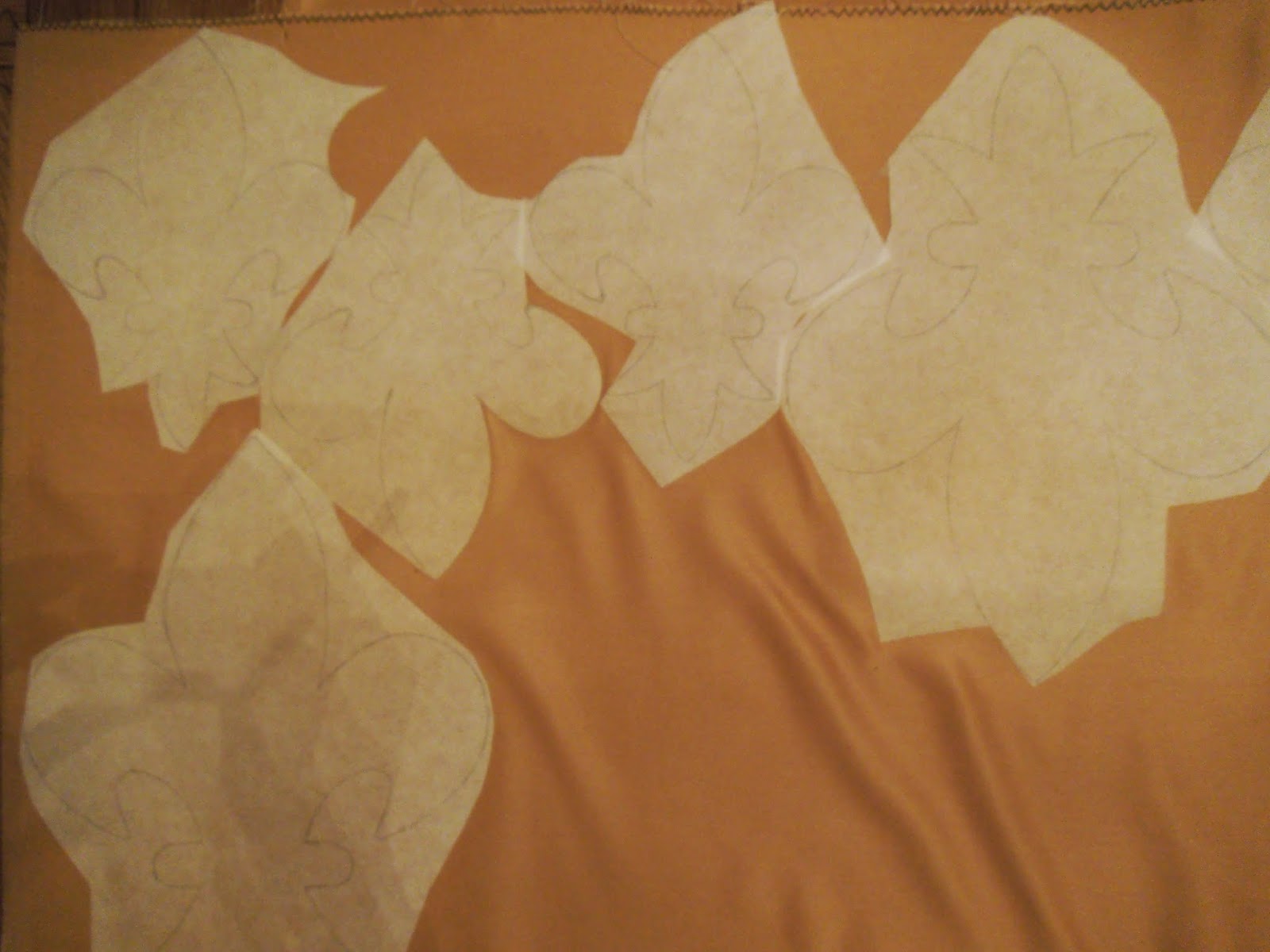
Miraculously I found some crincle-free blue fabric, yellow for the reverse and even golden satin for the fleur-de-lys with ease. And matching trim. And perfectly matching thread! Fate clearly favours the mad... I happened to find a roll of iron-on interfacing in my store (that I had bought previously for the sole reason that it was cheap and one might need 10+ metres of interfacing some day) to enforce the satin and make smooth, shiny lilies. Here they are, drawn, ironed-on and ready for cutting.
And to motivate myself for the tedious and meticulous (and thus swear-worthy) job of pinning them in place exactly and zig-zagging them onto the banner, I did a trial-version of each:


The banner itself is lined with plain, heavy fabric to enforce it, then the fleur-de-lys are sewn on.
And then comes the really tedious part... As a plain edge would be boring, I bought golden cord to frame the whole thing. Let's just say it took a lot of effort and other things to pin and sew it straight.
The idea:
The fleur-de-lys are sized A4, so the whole thing is pretty big. And as I couldn't decide whether to make a banner with six A4-sized or with three A3-sized lilies, I went for both. Why decide if you can have it all ;)
Miraculously I found some crincle-free blue fabric, yellow for the reverse and even golden satin for the fleur-de-lys with ease. And matching trim. And perfectly matching thread! Fate clearly favours the mad... I happened to find a roll of iron-on interfacing in my store (that I had bought previously for the sole reason that it was cheap and one might need 10+ metres of interfacing some day) to enforce the satin and make smooth, shiny lilies. Here they are, drawn, ironed-on and ready for cutting.
And to motivate myself for the tedious and meticulous (and thus swear-worthy) job of pinning them in place exactly and zig-zagging them onto the banner, I did a trial-version of each:
The banner itself is lined with plain, heavy fabric to enforce it, then the fleur-de-lys are sewn on.
And then comes the really tedious part... As a plain edge would be boring, I bought golden cord to frame the whole thing. Let's just say it took a lot of effort and other things to pin and sew it straight.
Subscribe to:
Comments (Atom)